Out of the Closet and Into the Streets by Emily Hardy
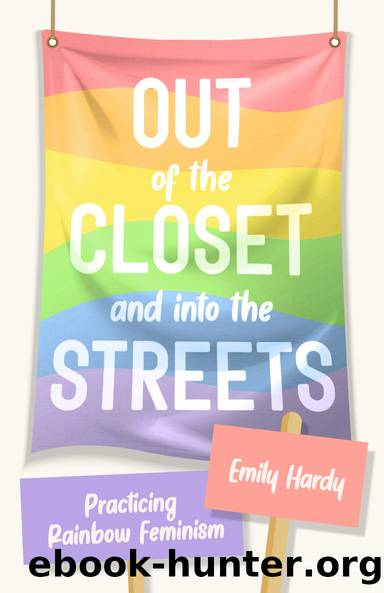
Author:Emily Hardy [Hardy, Emily]
Language: eng
Format: epub
Tags: Nonfiction, Social & Cultural Studies, Social Science, Gender Studies, Gay Studies, Feminism & Feminist Theory
ISBN: 9781636764917
Google: 9cqOzgEACAAJ
Barnesnoble:
Publisher: Emily Hardy
Published: 2021-08-26T00:00:00+00:00
Exclusivity in Action
Exclusivity inherent in the feminist movement remains incredibly dangerous. Just as exclusive concepts of womanhood in the First and Second Waves denied BIPOC people access to feminist spaces, TERF sects of the present enable similar forms of discrimination. Present production of gender and selective acceptance into feminist spaces are still steeped in cisgendered and heterosexual norms that fail to account for expression across the rainbow spectrum. The gendering of womanhood can be found in everything from targeted consumer branding at stores (a womenâs section) to menstrual products (often specifically labeled as feminine hygiene or womenâs products). In our conversation, Olivia noted the gendered branding of period products is one particular realm of gendering they find to be extremely harmful.
The exclusivity embedded in labels like feminine hygiene or womenâs only period products insinuate only women or feminine people can menstruate. Of course, this is far from the case. Trans, intersex, and nonbinary individuals (all of whom vary across the masc-femme spectrum) can simultaneously identify as something other than a woman and yet menstruate or need to use menstrual products. The flip side is also true: one does not need to menstruate in order to access womanhood, feminism, or femininity. Instead, the introduction of gender-neutral terminology like âmenstrual productsâ or âpeople who menstruateâ can create a far more inclusive space that recognizes the diversity of people who need such items without delegating gendered stigma or ostracizing Queer needs. To Olivia, âit is degrading to boil down womanhood to the vagina.â
Menstrual products, makeup, dresses, and colors are all examples of items that have been gendered and yet have no reason to be. Society has invented the gendering process and with it, norms dictating appropriate behavior. Inherent in constant gendering and the emergence of cis women-only spaces is the exclusion of individuals who donât conform to the cis man versus cis woman binary (trans and nonbinary) or male versus female paradigm (intersex). At the most fundamental level, feminism needs to recognize access to womanhood and feminism is no more predicated on genitalia than it is on oneâs skin color.
The common denial of trans women or nonbinary individualsâespecially masculine presenting or androgynous peopleâfrom accessing feminist spaces despite experiencing unique forms of gendered oppression is indicative of feminismâs attachment to binary concepts of sex and equality. Feminism has long since viewed masculinity as its enemy rather than the elements of WAATCCCH-patriarchy that have weaponized certain forms of masculinity to oppress people across the rainbow spectrum. Masculinity is not the problem. Plenty of individuals who perform masculinity simultaneously experience gendered oppression and discrimination. Rather, it is the institutions of WAATCCCH-patriarchy that need to be resisted through the process of ungendering the feminist definition. A vagina, uterus, or need to menstruate does not make someone a woman, nor does the absence of a vagina, uterus, or need to menstruate bar someone from being a woman. Woman is in the cultural mythology. It is in the invention of gender. It is in the process of socialization. And
Download
This site does not store any files on its server. We only index and link to content provided by other sites. Please contact the content providers to delete copyright contents if any and email us, we'll remove relevant links or contents immediately.
The remains of the day by Kazuo Ishiguro(9000)
Tools of Titans by Timothy Ferriss(8396)
Giovanni's Room by James Baldwin(7346)
The Black Swan by Nassim Nicholas Taleb(7130)
Inner Engineering: A Yogi's Guide to Joy by Sadhguru(6796)
The Way of Zen by Alan W. Watts(6614)
The Power of Now: A Guide to Spiritual Enlightenment by Eckhart Tolle(5783)
Asking the Right Questions: A Guide to Critical Thinking by M. Neil Browne & Stuart M. Keeley(5775)
The Six Wives Of Henry VIII (WOMEN IN HISTORY) by Fraser Antonia(5515)
Astrophysics for People in a Hurry by Neil DeGrasse Tyson(5190)
Housekeeping by Marilynne Robinson(4449)
12 Rules for Life by Jordan B. Peterson(4305)
Ikigai by Héctor García & Francesc Miralles(4275)
Double Down (Diary of a Wimpy Kid Book 11) by Jeff Kinney(4273)
The Ethical Slut by Janet W. Hardy(4253)
Skin in the Game by Nassim Nicholas Taleb(4250)
The Art of Happiness by The Dalai Lama(4130)
Skin in the Game: Hidden Asymmetries in Daily Life by Nassim Nicholas Taleb(4007)
Walking by Henry David Thoreau(3962)
